
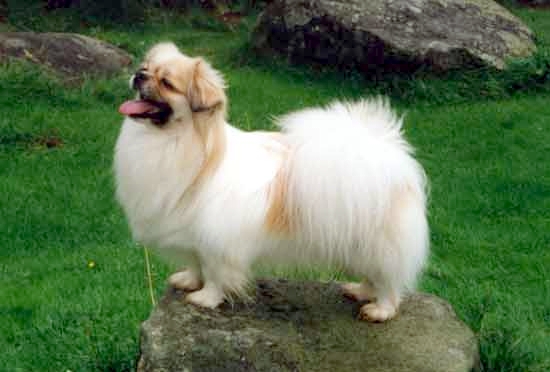
The Tibetan Spaniel has a domed head that is small,in comparison to the body. It has a short blunt muzzle. Teeth meet in an undershot or level bite. The nose is black. The eyes are medium but in keeping with the face and are set wide apart, these are oval in shape. The Tibetan Spaniel does not have extra skin around the eyes and this helps to tell the breed apart from the Pekingese. The ears hang down either side of the head to cheek level and are feathered with a v shape. The neck is covered in a mane of hair, which is more noticeable in the male of the breed. The Tibetan Spaniel's front legs are a little bowed and the feet are hare-like. This dog has a great feathered tail that is set high and is carried over their back. The coat is a silky double coat lying flat and is short and smooth on the face and leg fronts, it is medium in length on the body and has feathering on the ears, toes and tail. The Tibetan Spaniel dog can come in all colours and be solid, shaded and multi-coloured. Colours that are seen are red, fawn, gold, white, cream, black and tan, and black, and often there are white markings on the feet. By show standard this breed grows to about 10 inches and the weight is 9-15 pounds. Slightly larger Tibetan Spaniels can often be found outside the show ring.
Progressive Retinal Atrophy
Progressive retinal atrophy is a problem with this breed. The disease is an inherited form of blindness in dogs that occurs in two forms: generalized PRA and central PRA. Generalized PRA is primarily a photoreceptor disease and is the form found in Tibetan Spaniels. The clinical signs have been observed between 1½ and 4 years, but as late at seven years. The disease is painless and affected dogs become completely blind. Currently there is no treatment, but affected dogs generally adapt well to their progressive blindness.
The earliest clinical sign of progressive retinal atrophy is "night blindness." The dog cannot see well in a dimly lit room or at dusk. The dog will show a reluctance to move from a lighted area into darker surroundings. The night blindness develops progressively into complete blindness. The British institution Animal Health Trust (AHT) is at present intensively researching PRA in Tibetan Spaniels, aiming to isolate the responsible gene.
Liver Shunt - Portosystemic Shunt
A portosystemic shunt is an abnormal vessel that allows blood to bypass the liver, one of the body's filters, so that it is not cleansed. This condition is often referred to as a "liver shunt".Most shunts cause recognizable symptoms by the time a dog is a young adult but are occasionally diagnosed only later in life. Since the severity of the condition can vary widely depending on how much blood flow is diverted past the liver it is possible for a lot of variation in clinical signs and time of onset. Often, this condition is recognized after a puppy fails to grow, allowing early diagnosis. Signs of portosystemic shunts include poor weight gain, sensitivity to sedatives (especially diazepam), depression, pushing the head against a solid object, seizures, weakness, salivation, vomiting, poor appetite, increased drinking and urinating, balance problems and frequent urinary tract disease or early onset of bladder stones. A dramatic increase of these signs after eating is a strong supportive sign of a portosystemic shunt.
Other Issues
Like many breeds of dog, Tibetan Spaniels are susceptible to allergies. They also tend to experience "cherry eye", a prolapsed third eyelid. The shape of a Tibetan Spaniel's face makes them prone to "weeping eye".Source : wikipedia

No comments:
Post a Comment
Note: Only a member of this blog may post a comment.