
Description

From year to year, the tallest living dog is typically a Great Dane. Previous record holders include Gibson and Titan, however the current record holder is a blue Great Dane named Giant George who stands 43 in (110 cm) at the shoulder. He is also the tallest dog on record (according Guinness World Records),beating the previous holder who was a brindle Great Dane named Shamgret Danzas, who stood 42.5 in (108 cm) at the shoulder.
The minimum weight for a Great Dane over eighteen months is 120 lb (54 kg) for males, 100 lb (45 kg) for females. Unusually, the American Kennel Club dropped the minimum weight requirement from its standard. The male should appear more massive throughout than the female, with a larger frame and heavier bone.
Great Danes have naturally floppy, triangular ears. In the past, when Great Danes were commonly used to hunt boars, cropping of the ears was performed to make injuries to the dogs' ears less likely during hunts. Now that Danes are primarily companion animals, cropping is sometimes still done for traditional and cosmetic reasons. In the 1930s when Great Danes had their ears cropped, after the surgery two devices called Easter Bonnets were fitted to their ears to make them stand up. Today, the practice is common in the United States and much less common in Europe. In some European countries such as the United Kingdom, Ireland, Denmark, Germany, parts of Australia, and in New Zealand, the practice is banned, or controlled to only be performed by veterinary surgeons.
Coat colors

Blue puppy

- Fawn: The color is yellow gold with a black mask. Black should appear on the eye rims and eyebrows, and may appear on the ears.
- Brindle: The color is fawn and black in a chevron stripe pattern. Often also they are referred to as having a tiger-stripe pattern.
- Blue: The color is a pure steel blue. White markings at the chest and toes are not desirable and considered faults.
- Black: The color is a glossy black. White markings at the chest and toes are not desirable and considered faults.
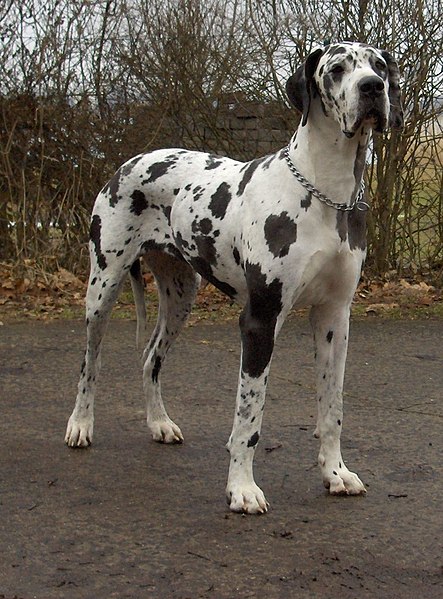
- Harlequin: The base color is pure white with black torn patches irregularly and well distributed over the entire body; a pure white neck is preferred. The black patches should never be large enough to give the appearance of a blanket, nor so small as to give a stippled or dappled effect. Eligible, but less desirable, are a few small grey patches (this grey is consistent with a Merle marking) or a white base with single black hairs showing through, which tend to give a salt and pepper or dirty effect. (Have the same link to deafness and blindness as Merle and white danes.)
- Mantle (in some countries referred to as Bostons due to the similar coloration and pattern as a Boston Terrier): The color is black and white with a solid black blanket extending over the body; black skull with white muzzle; white blaze is optional; whole white collar preferred; a white chest; white on part or whole of forelegs and hind legs; white tipped black tail. A small white marking in the black blanket is acceptable, as is a break in the white collar
Temperament
The Great Dane's large and imposing appearance belies its friendly nature; the breed is often referred to as a gentle giant. Great Danes are generally well-disposed toward other dogs, other non-canine pets, and humans. They generally do not exhibit a high prey drive. The Great Dane is a very gentle and loving animal with proper care and training. A Great Dane is great for small children and a loving family as long as it grows up in the family from a pup. However if not socialized from a pup can be very aggressive towards other dogs.Exercise

Given their large size, Great Danes continue to grow (mostly gaining weight) longer than most dogs. Even at one year of age a Great Dane will continue to grow for several more months.

A Merle Great Dane
Health
Great Danes, like most giant dogs, have a fairly slow metabolism. This results in less energy and less food consumption per pound of dog than in small breeds. Great Danes have some health problems that are common to large breeds, including gastric dilatation-volvulus (GDV). The average life span of Great Danes is 6 to 8 years. Like many larger breeds, Great Danes are at particular risk for hip dysplasia.Dilated cardiomyopathy (DCM) and many congenital heart diseases are also commonly found in the Great Dane, leading to its nickname: the Heartbreak breed, in conjunction with its shorter lifespan. Great Danes also suffer from several genetic disorders that are specific to the breed. For example, if a Great Dane lacks color (is white) near its eyes or ears, then that organ may not develop and usually the dog will be either blind, deaf, or both.
Source : wikipedia

No comments:
Post a Comment
Note: Only a member of this blog may post a comment.