
Description
Appearance
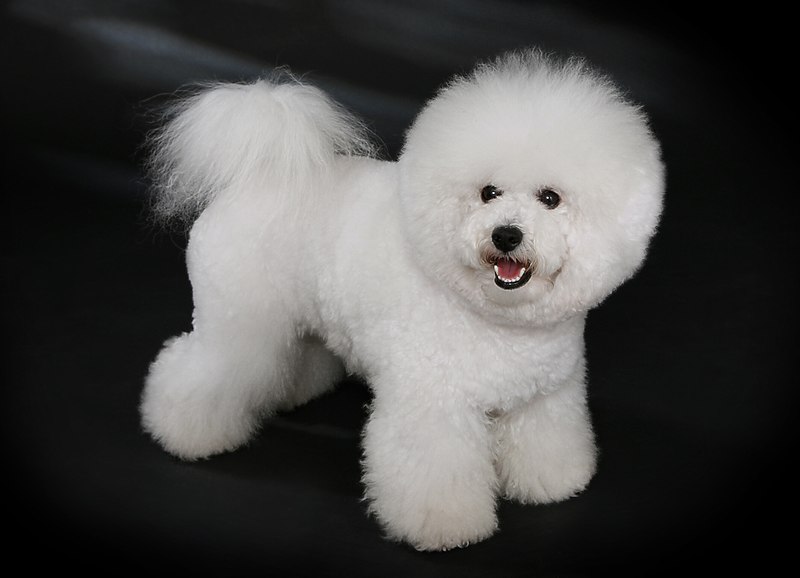
The Bichon Frise is a small dog that weighs approximately 5 – 10 kg (10 - 20 lbs) and stands 23 – 30 cm (9 – 12 in) at the withers, but slightly larger dogs are not uncommon. The skull is slightly rounded and the muzzle is not pointy. The tail is groomed to be long and curly and is carried over the back. It has a black nose and dark round eyes, its white hair consists of a curly and coarse outercoat and a silky and dense undercoat, although many of the breed do tend to have less curly hair than others. A small amount of buff, cream, or apricot color may be seen around its ears, snout, paws or body, but normally these colors do not exceed 10% of its body. Coat colors are solid white, apricot or grey. A white coat is preferred in the show ring. The head and legs are proportionate in size to the body, and the ears and tail are natural (not docked or cropped).The coat is trimmed often to make the hair seem like an even length. Bichon Frises can have a medium-high intelligence.Temperament
The American Kennel Club (AKC) refers to the Bichon Frise as "merry" and "cheerful", and the breed standard calls for a dog that is "gentle mannered, sensitive, playful and affectionate". The Bichon Frise loves human company and demands much of your attention. They are generally very sociable and do well with a family that takes them everywhere. They are charming, affectionate, and intelligent. They do well with children because they are playful and have lots of energy. Bred to be companion dogs, the Bichon Frise tends to get along well with both children and other animals.Bichon Frises are very obedient if training is started early and continued consistently.
Lifespan
Bichon Frise in (combined)UK and USA/Canada surveys had an average life span of about 12–13 years, with Bichon Frises in the UK tending to live longer than Bichon Frises in the US/Canada. This breed's longevity is similar to other breeds of its size, and somewhat longer than purebred dogs in general. The longest lived of 34 deceased Bichons in a 2004 UK survey died at 16.5 years.The oldest Bichon Frises for which there are reliable records in various US/Canada surveys have died at 19 years.
In a 2004 UK Kennel Club survey, the leading causes of Bichon Frise death were old age (23.5%) and cancer (21%). In a 2007 USA/Canada breeders survey, the leading causes of death were cancer (22%), unknown causes (14%), hematologic (11%), and old age (10%). Hematologic causes of death were divided between autoimmune hemolytic anemia (AIHA) and immune-mediated thrombocytopenia (ITP). AIHA and ITP were responsible for the greatest amount of Bichon Frise "years lost." "Years lost" is a measure of the extent to which a condition kills members of a breed prematurely. While cancer is a more common cause of death than AIHA/ITP, Bichon Frises that died of cancer died at a median age of 12.5 years. Hematologic deaths occurred at a median age of only 5 years. Bichon Frises in the UK survey had a lower rate of hematologic deaths (3%) than in the USA/Canada survey (11%).
Bichons are also prone to liver shunts. These often go undetected until later in life, leading to complications that cannot be fixed, and therefore liver failure. Bichons who are underweight, runts of the litter, or have negative reactions to food high in protein are likely to be suffering from a shunt. When detected early, shunt often can be corrected through surgery. However, the later in life the shunt is detected, the lower the likelihood of surgery being a success. Shunts can be kept under control through special diets of low protein and through medications to support liver function, help flush toxins that build up in the kidneys and liver, and control seizures that often occur as a symptom of the shunt. Without surgery, Bichons with shunts on average live to be 4–6 years old. Owners of a smaller than average size bichon must consult a vet. Other symptoms include dark urine, lethargy, loss of appetite, increase in drinking. Seizures come in all forms; episodes of seizures can begin early on but go undetected. Early seizures can appear to be the bichon in a hypnotic state (staring at something not there), or to be experiencing an episode of vertigo, or being drunk. Shunts are a serious condition of smaller breeds, and often not associated with Bichons.
Source : wikipedia

No comments:
Post a Comment
Note: Only a member of this blog may post a comment.