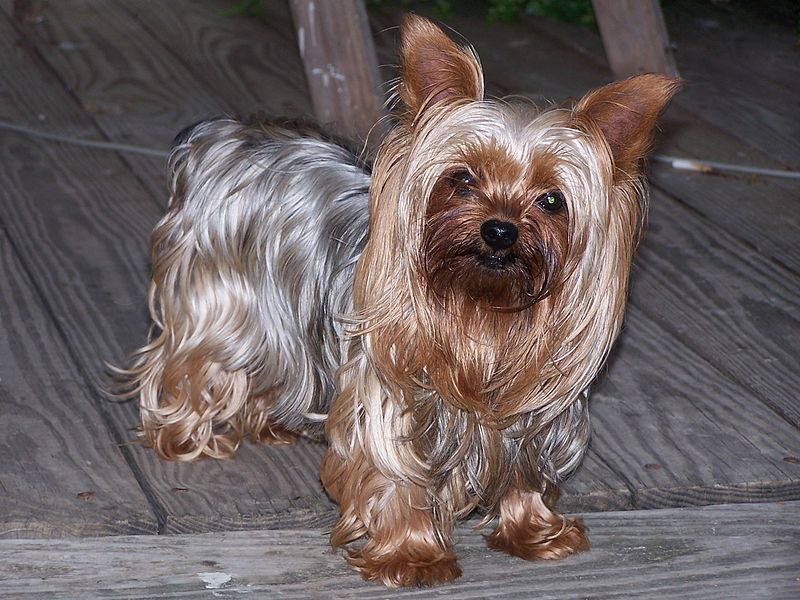
The Yorkshire Terrier is a small dog breed of terrier type, developed in the 19th century in the county of Yorkshire, England to catch rats in clothing mills. The defining features of the breed are its size, 3 pounds (1.4 kg) to 7 pounds (3.2 kg), and its silky blue and tan coat. The breed is nicknamed Yorkie and is placed in the Toy Terrier section of the Terrier Group by the Fédération Cynologique Internationale and in the Toy Group or Companion Group by other kennel clubs, although all agree that the breed is a terrier. A popular companion dog, the Yorkshire Terrier has also been part of the development of other breeds, such as the Australian Silky Terrier.
For adult Yorkshire Terriers, importance is placed on coat color, quality, and texture.The hair must be glossy, fine, straight, and silky. Traditionally the coat is grown-out long and is parted down the middle of the back, but "must never impede movement."
From the back of the neck to the base of the tail, the coat should be a dark gray to a steel-blue, and the hair on the tail should be a darker blue. On the head, high chest, and legs, the hair should be a bright, rich tan, darker at the roots than in the middle, that shades into a lighter tan at the tips. Also, in adult dogs, there should be no dark hairs intermingled with any of the tan coloured fur.
Adult Yorkshire Terriers that have other coat colours than the above, or that have woolly or extra fine coats, are still considered to be Yorkshire Terriers, and will be just as good of a companion as a dog with the correct coat. The only difference is that atypical Yorkshire Terriers should not be bred. In addition, care may be more difficult for "woolly" or "cottony" textured coats, or coats that are overly fine. One of the reasons given for not breeding "off-coloured" Yorkies is that the colour could be a potential indicator of a genetic defect that may affect the dog's health, a careful health screening can clarify if any health risks exist or not.
Source : wikipedia
For adult Yorkshire Terriers, importance is placed on coat color, quality, and texture.The hair must be glossy, fine, straight, and silky. Traditionally the coat is grown-out long and is parted down the middle of the back, but "must never impede movement."
From the back of the neck to the base of the tail, the coat should be a dark gray to a steel-blue, and the hair on the tail should be a darker blue. On the head, high chest, and legs, the hair should be a bright, rich tan, darker at the roots than in the middle, that shades into a lighter tan at the tips. Also, in adult dogs, there should be no dark hairs intermingled with any of the tan coloured fur.
Adult Yorkshire Terriers that have other coat colours than the above, or that have woolly or extra fine coats, are still considered to be Yorkshire Terriers, and will be just as good of a companion as a dog with the correct coat. The only difference is that atypical Yorkshire Terriers should not be bred. In addition, care may be more difficult for "woolly" or "cottony" textured coats, or coats that are overly fine. One of the reasons given for not breeding "off-coloured" Yorkies is that the colour could be a potential indicator of a genetic defect that may affect the dog's health, a careful health screening can clarify if any health risks exist or not.
Source : wikipedia
No comments:
Post a Comment
Note: Only a member of this blog may post a comment.