
Description
Appearance
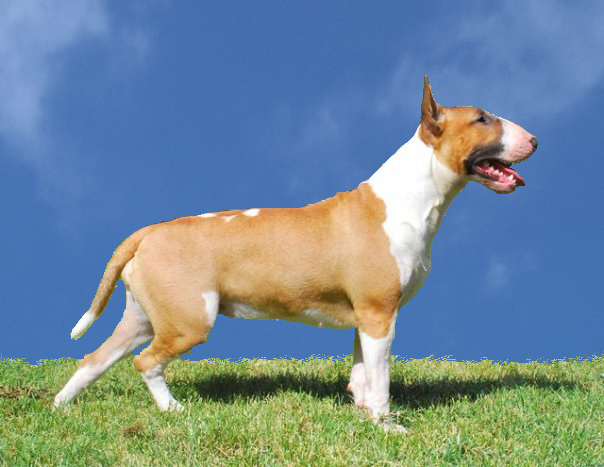
The Bull Terrier's most recognizable feature is its head, described as 'egg shaped' when viewed from the front, the top of the skull is almost flat from ear to ear. Profile curves gently downwards from top of skull to tip of nose which should be black and bent downwards at tip. Nostrils are well developed and under-jaw deep and strong snout. The unique triangle-shaped eyes are small, dark, and deep-set. The body is full and round, while the shoulders are robust and very muscular and the tail is carried horizontally. It walks with a jaunty gait, and is popularly known as the 'gladiator of the canine race'.Temperament
Although there is much discussion regarding the safety of owning a Bull Terrier, the American Temperament Test Society (ATTS), which performs temperament tests in an effort to weed out potentially dangerous dogs from breeding programmes and to educate dog owners, reports consistently high pass rates, around 90%, for Bull Terriers. Generally, Bull Terriers are no more or less aggressive towards people than any other dog. A Washington Animal Foundation human fatalities survey in 2001 found none caused by Bull Terriers.The Bull Terrier is a fun, comical, people-loving dog. They are known to be courageous, scrappy, fun-loving, active, clownish and fearless. They enjoy being around people, sometimes a little too much, and can prove positively dangerous to people of a delicate nature, not through malicious intent, but rather through their exuberance; as such the Bull Terrier is not recommended for households with small children if the owner is a first time Bull Terrier owner. But then again no animals should be left alone with a child., or the elderly and infirm. Bull Terriers can be both independent and stubborn and for this reason is not considered suitable for an inexperienced dog owner. A firm hand and an assertive demeanour are essential if the Bull Terrier is not to run riot. They are also fiercely protective although comprehensive socialisation at an early age will prevent them becoming over-protective and neurotic.
When it comes to other animals, caution should be the byword. Bull Terriers have a strong prey instinct and can cause injury or death to other animals, especially cats. That said, puppies brought up or socialised with cats and other animals can get on well with the animals they know; they can never be completely trusted with other animals. With other dogs, unaltered males may not get along with other male dogs. Males and females can live together happily, and two females can also be a good combination with care and supervision. Introducing a Bull Terrier of the same gender as the dog in residence is considered unwise, and some Bull Terriers won't countenance any other dogs, of either gender .
Health
All puppies should be checked for deafness, which occurs in 20% of pure white dogs and 1.3% of dogs and is difficult to notice, especially in a relatively young puppy. Many Bull Terriers have a tendency to develop skin allergies. Insect bites, such as those from fleas, and sometimes mosquitoes and mites, can produce a generalized allergic response of hives, rash, and itching. This problem can be stopped by keeping the dog free of contact from these insects, but this is definitely a consideration in climates or circumstances where exposure to these insects is inevitable. Their average lifespan is around 9–12 years, although they may live longer.Source : wikipedia

No comments:
Post a Comment
Note: Only a member of this blog may post a comment.